ex10_asymmetric_windows
This example separates the effects of asymmetric taper ratios from those of
using different window functions along x, y, and z. The primary value is 8,
the secondary value is 2, and the dashed orange outlines mark the primary
support within x/y/z = 15/85.
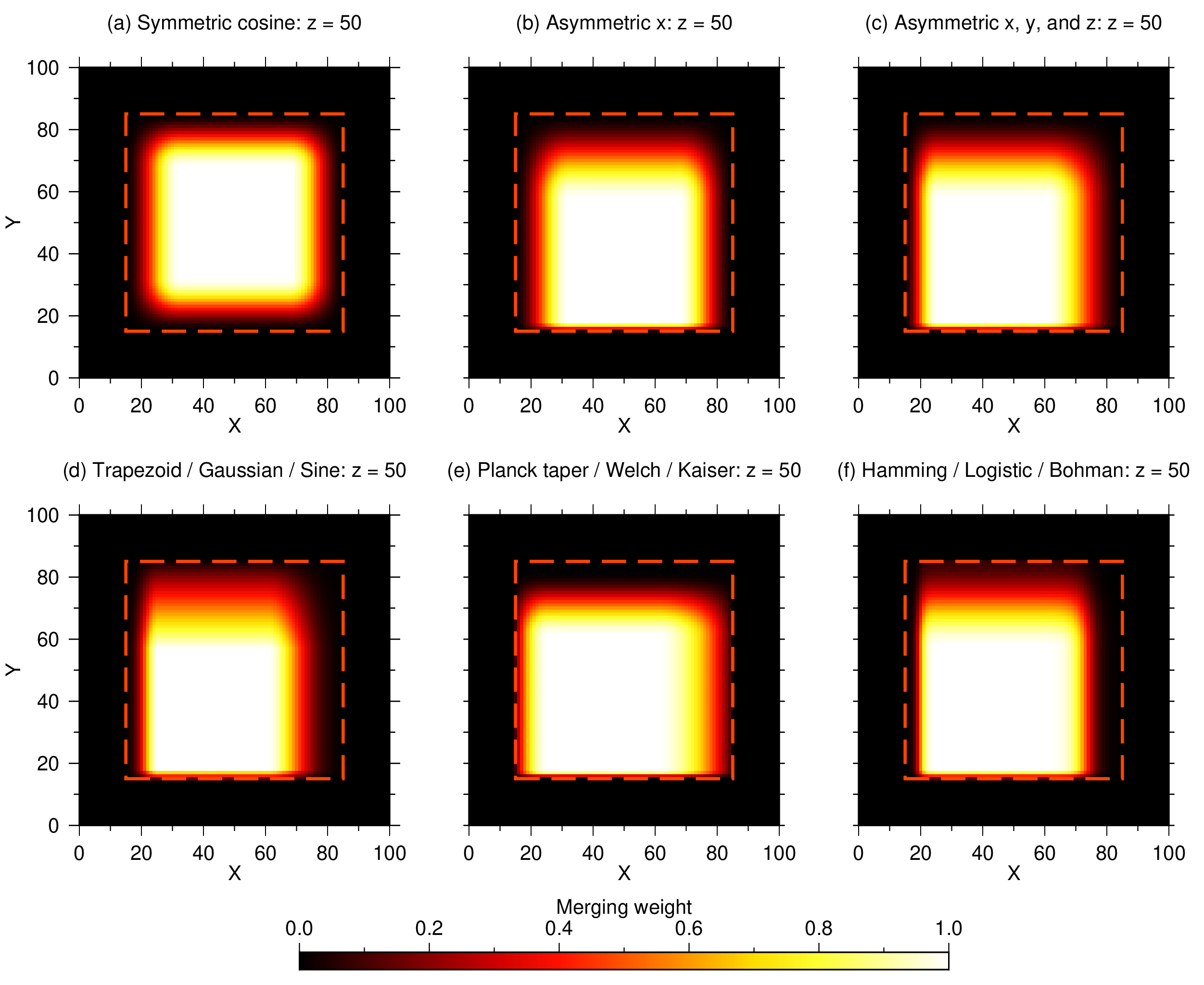
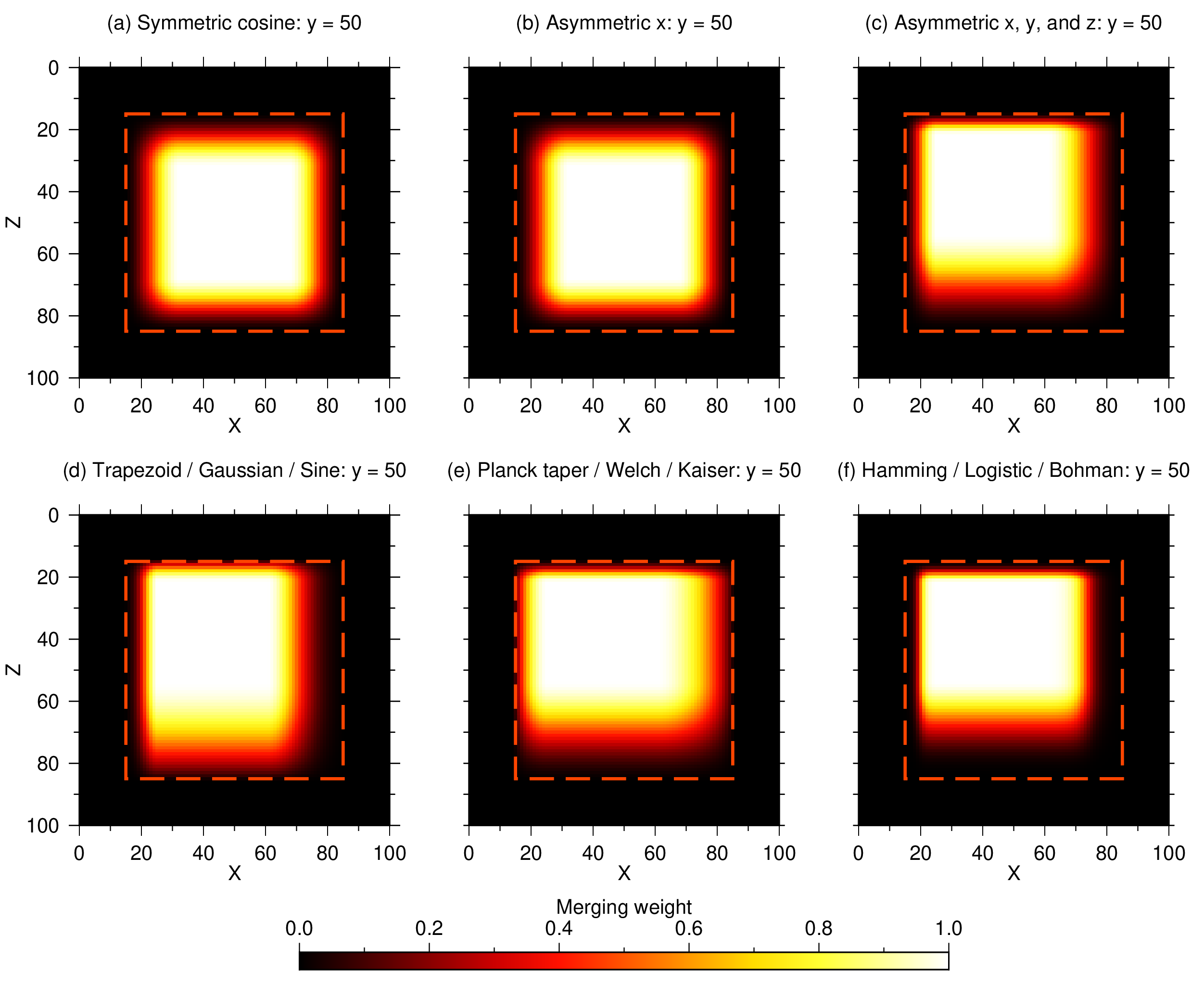
The first configuration is symmetric in all three directions:
primary secondary - - cosine/cosine/cosine 0.25
The next two configurations first make only the x ratios asymmetric and then make all six directional ratios different:
primary secondary - - cosine/cosine/cosine 0.05/0.40/0.25/0.25/0.25/0.25
primary secondary - - cosine/cosine/cosine 0.05/0.40/0.15/0.35/0.10/0.45
The six values specify the west, east, south, north, upper, and lower taper ratios. A smaller ratio creates a narrower transition from zero to one, while a larger ratio extends the transition farther into the support.
The final three configurations retain all six asymmetric ratios while changing the directional function triplets:
primary secondary - - trapezoid/gaussian/sine  0.05/0.40/0.15/0.35/0.10/0.45
primary secondary - - plancktaper/welch/kaiser  0.05/0.40/0.15/0.35/0.10/0.45
primary secondary - - hamming/logistic/bohman   0.05/0.40/0.15/0.35/0.10/0.45
The horizontal figure shows weights at z = 50 and isolates x/y behavior. The vertical figure shows weights along y = 50 and exposes x/z behavior. The secondary is the final fallback record in every mergefile.
Run:
./ex10_asymmetric_windows.sh
The script verifies baseline symmetry, the expected directional bias from the
six asymmetric ratios, distinct mixed-window results in both views, and the
exact merged relation cube = 2 + 6 * weight. It creates:
ex10_asymmetric_windows_horizontal.pngandex10_asymmetric_windows_horizontal.pdfex10_asymmetric_windows_vertical.pngandex10_asymmetric_windows_vertical.pdf
Figures