ex16_cascadia_models
This high-taper example repeats ex12_cascadia_models, using 0.49 on every
side except the beginning of the z axis, which remains zero.
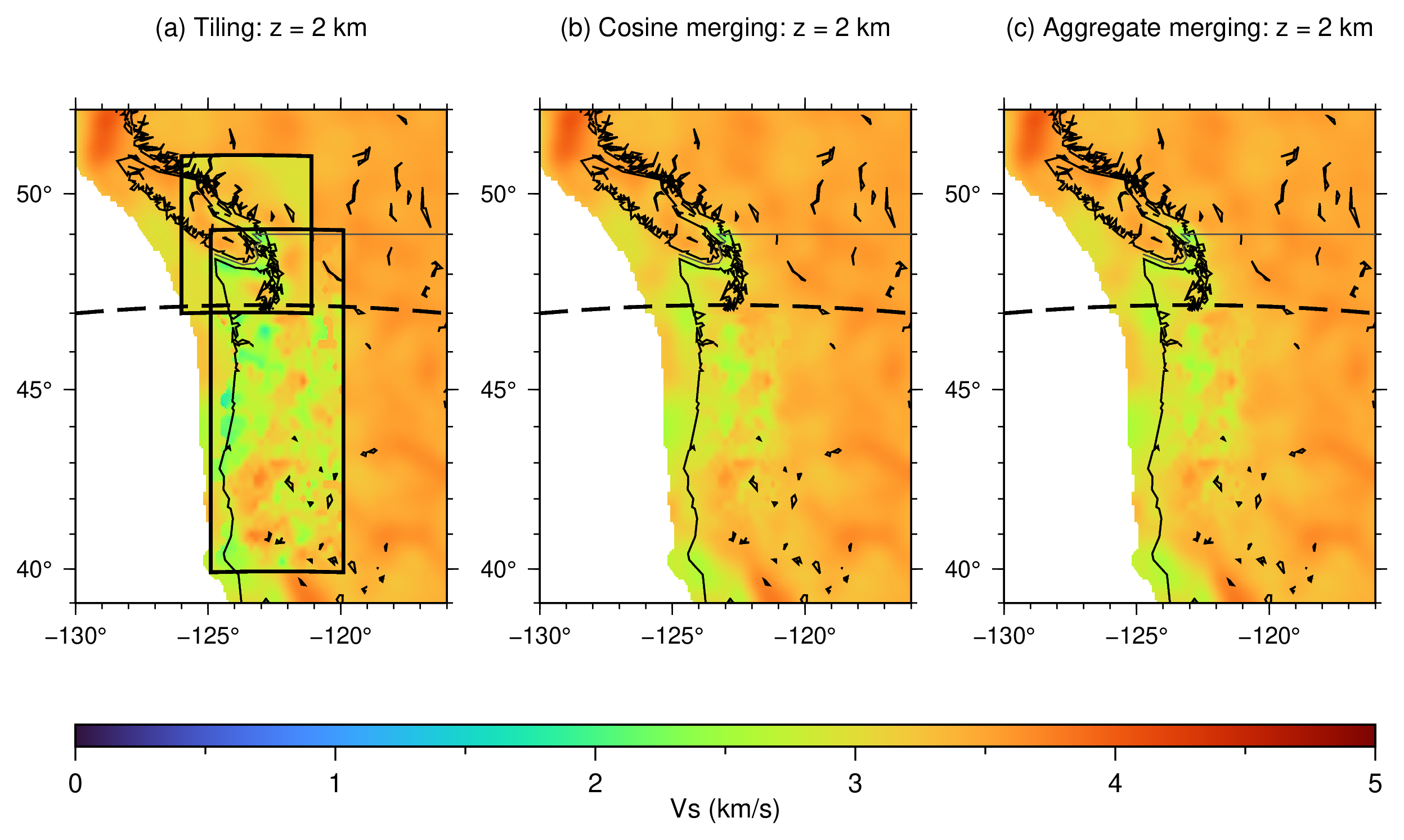
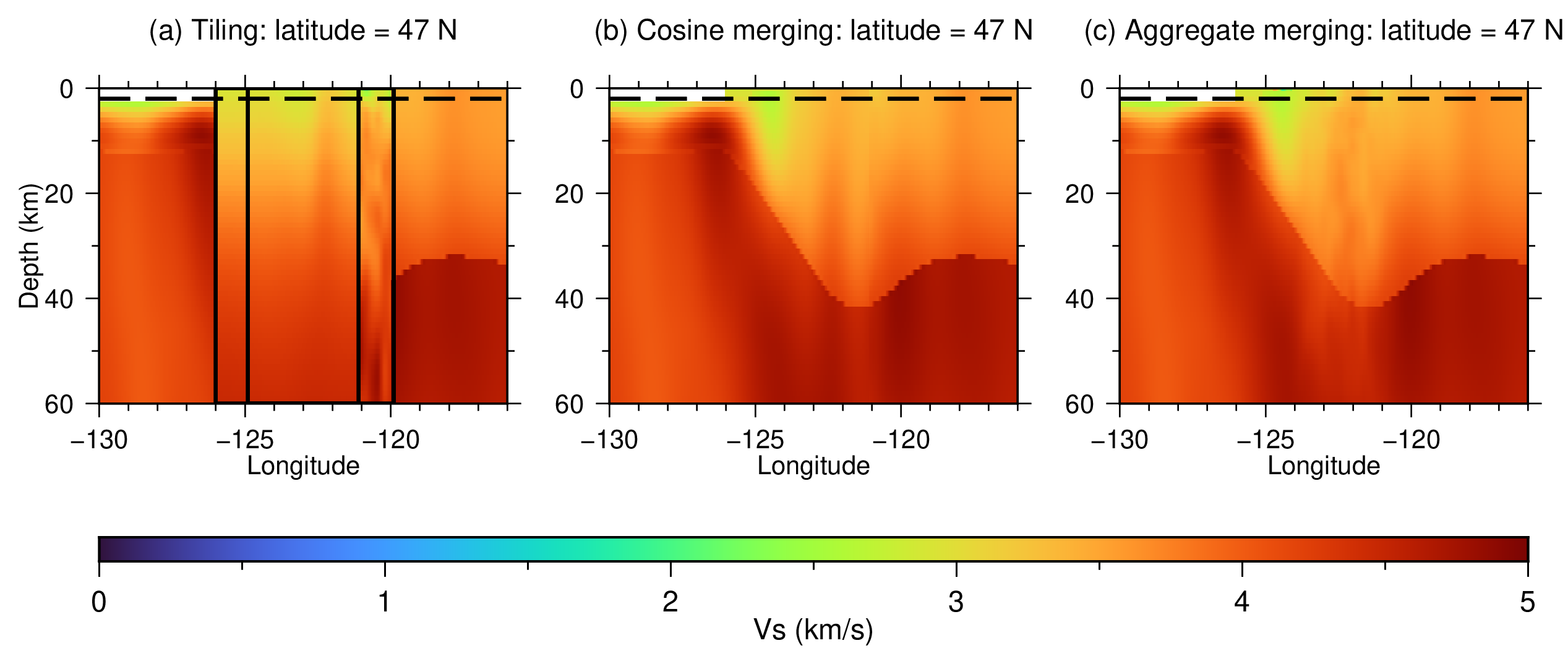
This example compares three-dimensional tiling, regular cosine merging, and aggregate cosine merging for Cascadia shear-wave velocity models. It uses this first-availability order:
SVI EQTOMO
Cascadia ANT+RF
WUS324 Cascadia
Both regional primaries are paired with WUS324 in the mergefile:
SVI_EQTOMO     WUS324 - - cosine/cosine/cosine 0.49/0.49/0.49/0.49/0/0.49
Cascadia_ANT+RF WUS324 - - cosine/cosine/cosine 0.49/0.49/0.49/0.49/0/0.49
WUS324          -      - - -                    -
The six ratios represent west, east, south, north, beginning-z, and ending-z
tapers. The beginning-z ratio is zero, so regional model weights are not
tapered away at the shallow boundary. The ending-z ratio remains 0.2.
All three selectors use +Vkm/s to declare common target-unit metadata.
The output covers longitude/latitude = -130/-116/39/52 and depths from 0 to
60 km. The horizontal figure shows z = 2 km and marks the latitude = 47 N vertical
section with a dashed black line. The vertical figure shows that section and
marks z = 2 km. Solid black outlines appear only on the tiling panels and mark
the two primary model domains.
Panel (a) uses first-availability tiling, panel (b) uses regular merging, and
panel (c) uses aggregate merging to normalize weights where the primary
supports overlap. The -P option fills remaining primary gaps from WUS324
after interpolation.
The full public NetCDF models are downloaded and cached by
prepare_vs_slices.sh in the shared data directory.
Run:
./ex16_cascadia_models.sh
The script verifies that regular merging changes tiling and that aggregate normalization changes the regular result in both plotted sections. It creates:
ex16_cascadia_models_horizontal.pngandex16_cascadia_models_horizontal.pdfex16_cascadia_models_vertical.pngandex16_cascadia_models_vertical.pdf
Figures