ex17_cascadia_models
This high-taper example repeats ex13_cascadia_models with taper ratios of
0.49.
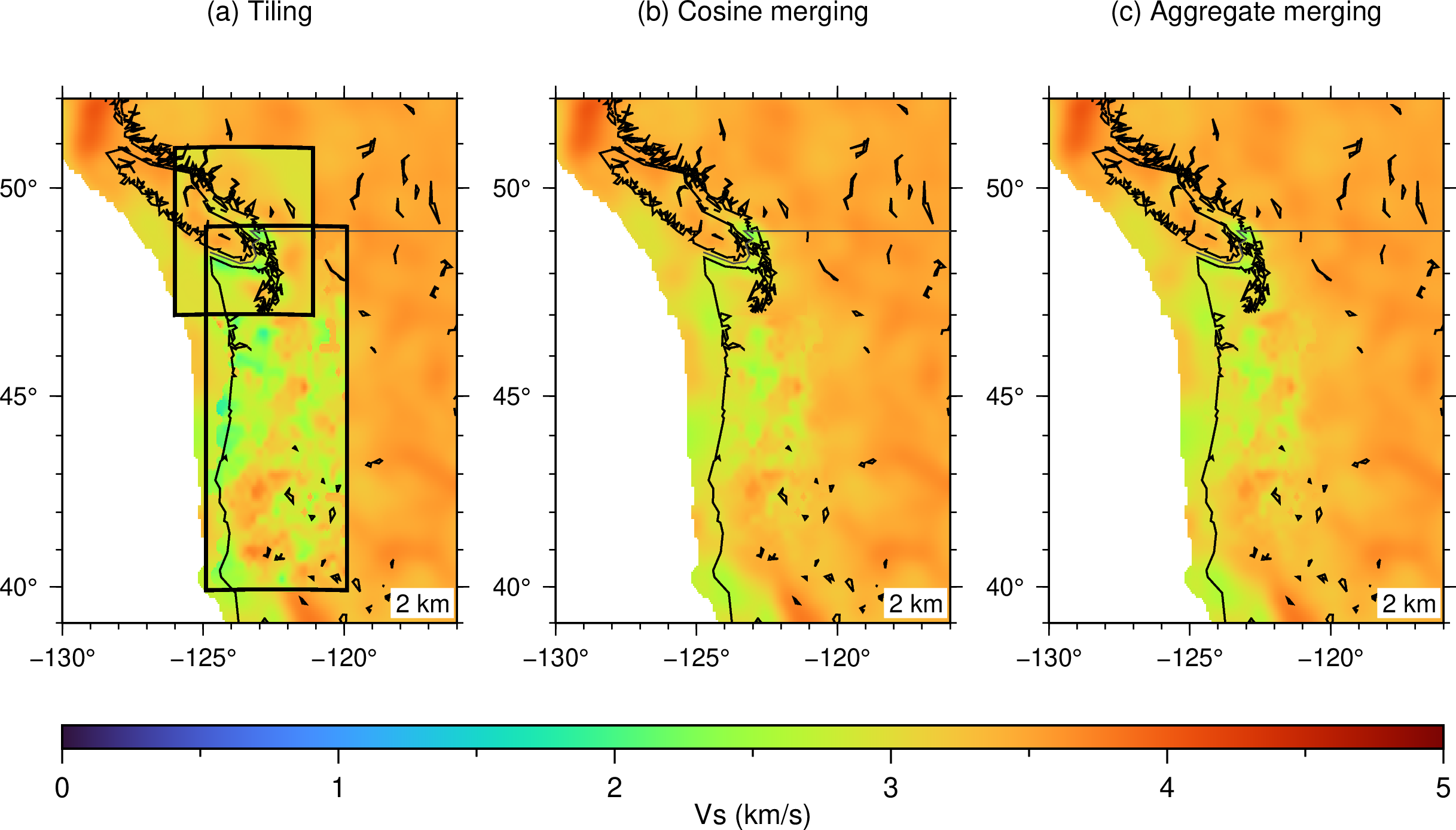
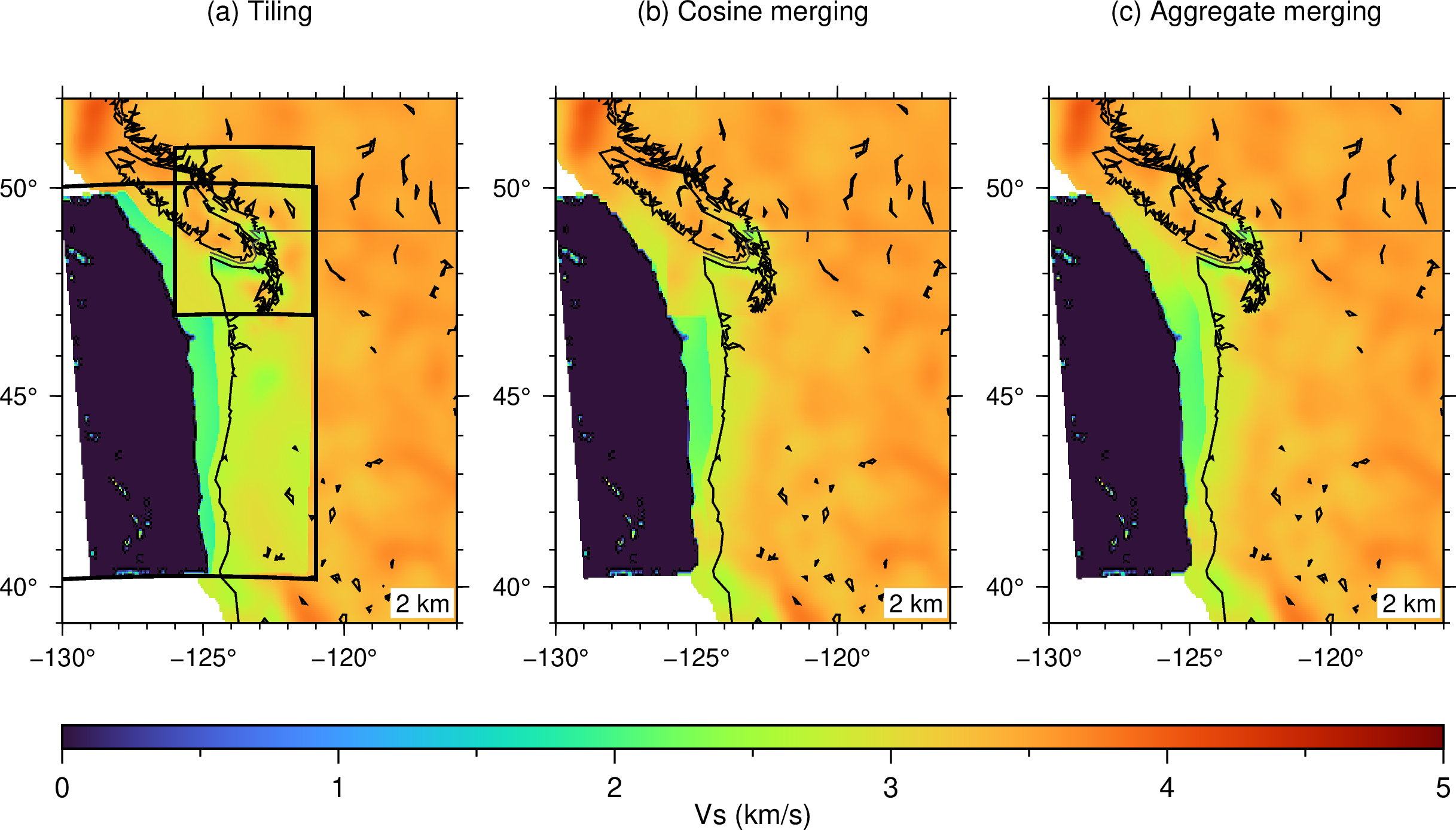
This example creates two figures comparing tiling, regular cosine merging, and aggregate cosine merging for shear-wave velocity models at 2 km depth.
The first figure uses this tiling order:
SVI EQTOMO
Cascadia ANT+RF
WUS324 Cascadia
Its mergefile pairs both regional primaries with WUS324:
SVI_EQTOMO WUS324 - cosine/cosine 0.49
Cascadia_ANT+RF WUS324 - cosine/cosine 0.49
WUS324 - - - -
The second figure replaces Cascadia ANT+RF with Cascadia v1.6:
SVI EQTOMO
Cascadia v1.6
WUS324 Cascadia
SVI_EQTOMO WUS324 - cosine/cosine 0.49
Cascadia_v1.6 WUS324 - cosine/cosine 0.49
WUS324 - - - -
In both figures, panel (a) uses first-availability tiling, panel (b) uses
regular symmetric cosine merging, and panel (c) uses aggregate merging to
normalize the weights where the primary supports overlap. All windows use
taper ratios of 0.49. Solid black lines in panel (a) outline the two primary
domains. The -P option fills remaining gaps in a primary from its paired
WUS324 model.
Cascadia v1.6 is converted from meters and m/s to kilometers and km/s, then
reprojected from UTM Zone 10. All input models and 2 km slices are downloaded
and cached by prepare_vs_slices.sh in the shared data directory.
Run:
./ex17_cascadia_models.sh
The script creates:
ex17_cascadia_ant_rf.png
ex17_cascadia_ant_rf.pdf
ex17_cascadia_v16.png
ex17_cascadia_v16.pdf
Figures