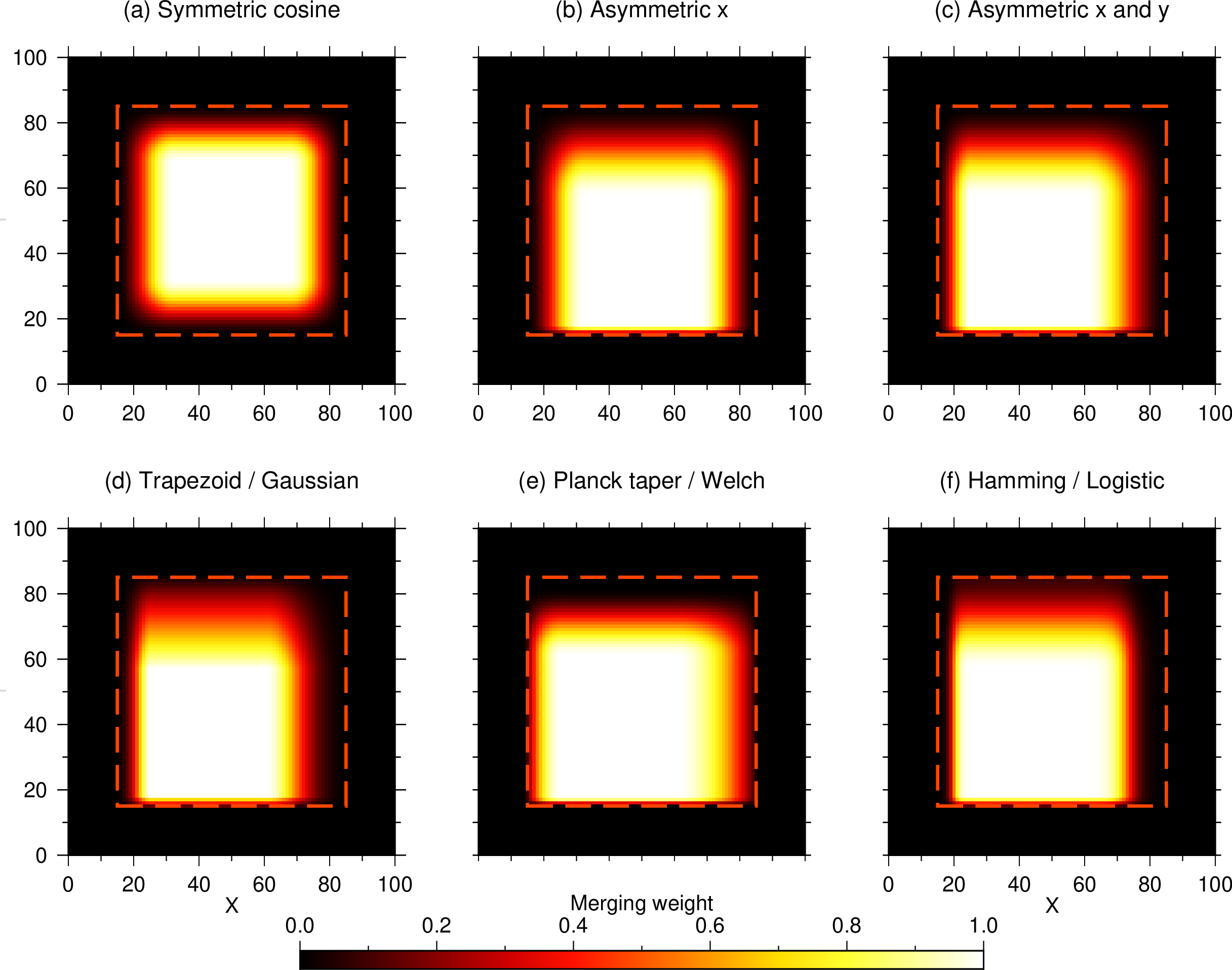
ex11_asymmetric_windows
This example separates the effects of asymmetric taper ratios from the effects
of using different window functions along x and y. Every primary has value 8,
the secondary has value 2, and the dashed orange square marks the primary
support within -R15/85/15/85.
The top row first uses a symmetric cosine configuration:
primary secondary - cosine/cosine 0.25
It then changes the west and east ratios before making all four ratios different:
primary secondary - cosine/cosine 0.05/0.40/0.25/0.25
primary secondary - cosine/cosine 0.05/0.40/0.15/0.35
The four values specify the west, east, south, and north taper ratios. A small ratio produces a narrow transition from zero to one, while a larger ratio extends the transition farther into the support.
The bottom row retains 0.05/0.40/0.15/0.35 and changes the function pair:
primary secondary - trapezoid/gaussian  0.05/0.40/0.15/0.35
primary secondary - plancktaper/welch   0.05/0.40/0.15/0.35
primary secondary - hamming/logistic    0.05/0.40/0.15/0.35
The first function operates along x and the second operates along y. The resulting two-dimensional weight is the product of those directional windows. The secondary is listed as a final fallback record in every mergefile.
Run:
./ex11_asymmetric_windows.sh
The script verifies symmetry in the baseline, the expected westward and
southward bias from the asymmetric ratios, distinct mixed-window results, and
the exact merged relation z = 2 + 6 * weight. It creates
ex11_asymmetric_windows.png and ex11_asymmetric_windows.pdf.
Figures