ex10_window_functions
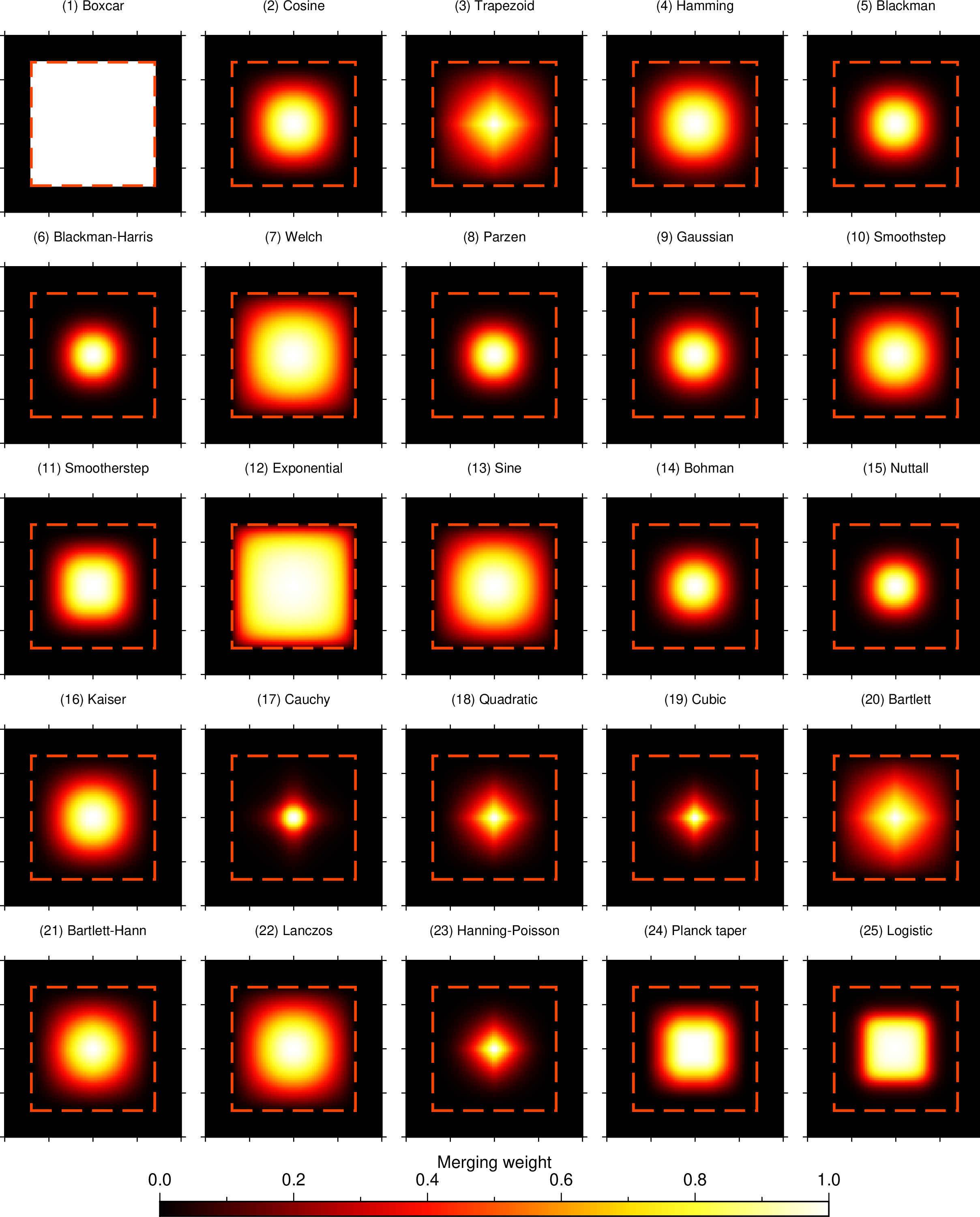
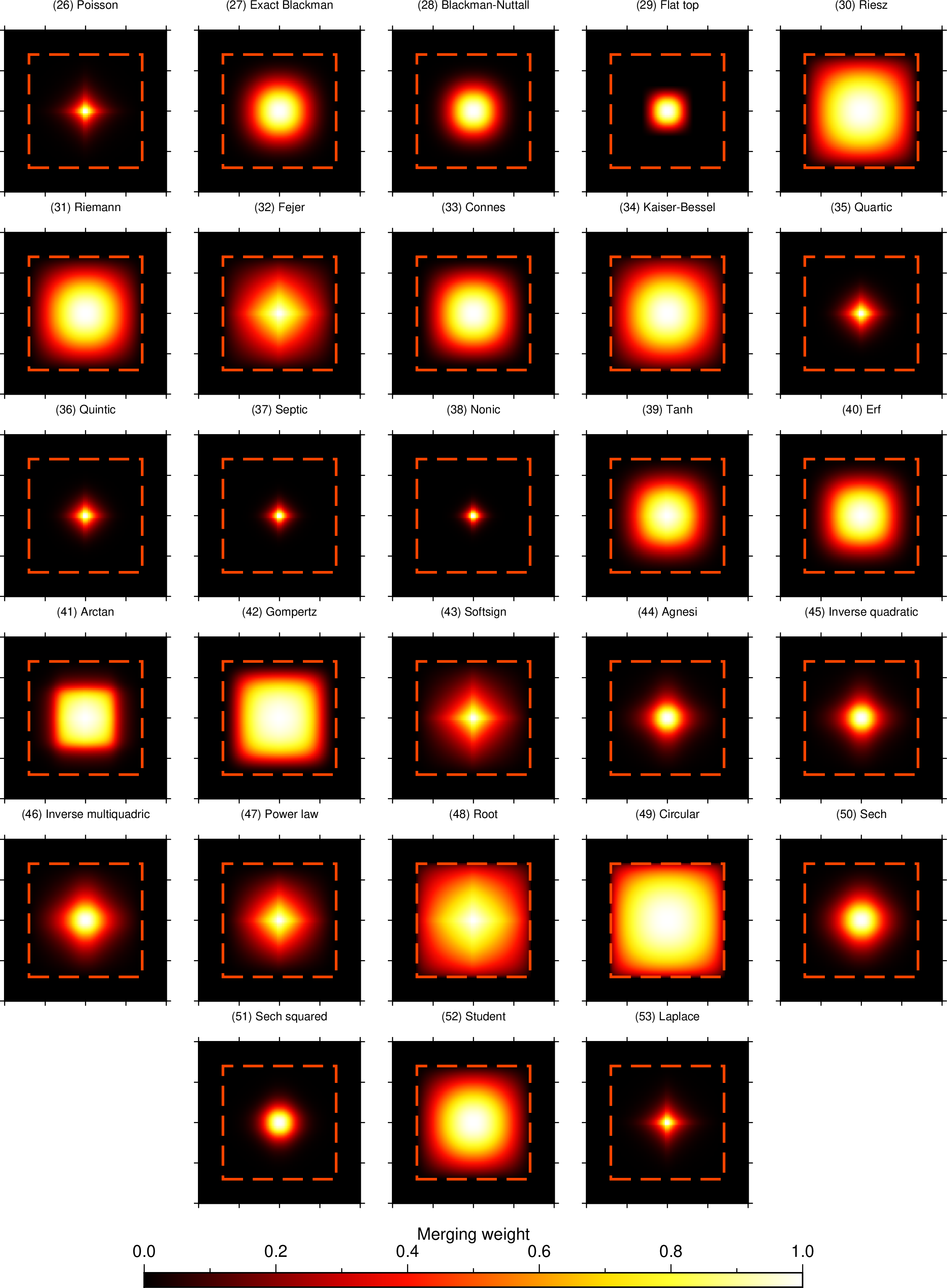
This example compares all 53 unique BLEND window implementations through the
two-dimensional merging weights generated by merge2d. The results are split
between two figures. Every panel uses the same primary support, output domain,
grid spacing, and symmetric taper ratio, so only the window function changes.
The primary occupies -R15/85/15/85 inside the full -R0/100/0/100 output
domain. Each mergefile uses the form:
primary secondary - function/function 0.49
secondary - - - -
Using the same function in x and y produces a separable two-dimensional
weight. The taper ratio of 0.49 leaves only a small full-weight region and
makes differences between the edge profiles easier to see. The dashed orange
square marks the primary support.
The first figure includes:
boxcar          cosine          trapezoid       hamming          blackman
blackmanharris  welch           parzen          gaussian         smoothstep
smootherstep    exponential     sine            bohman           nuttall
kaiser          cauchy          quadratic       cubic            bartlett
bartletthann    lanczos         hanningpoisson  plancktaper      logistic
The second figure includes the remaining implementations:
poisson               exactblackman    blackmannuttall       flattop      riesz
riemann               fejer            connes                kaiserbessel quartic
quintic               septic           nonic                 tanh         erf
arctan                gompertz         softsign              agnesi       inversequadratic
inversemultiquadric   powerlaw         root                  circular     sech
sech2                 student          laplace
Several additional BLEND names are aliases. For example, hann and tukey
select the cosine implementation, linear selects trapezoid, and barthann
selects Bartlett-Hann.
Run:
./ex10_window_functions.sh
The script verifies that every weight grid contains no missing nodes and stays
within the interval from zero to one. It creates ex10_window_functions.png,
ex10_window_functions.pdf, ex10_window_functions_remaining.png, and
ex10_window_functions_remaining.pdf.
Figures